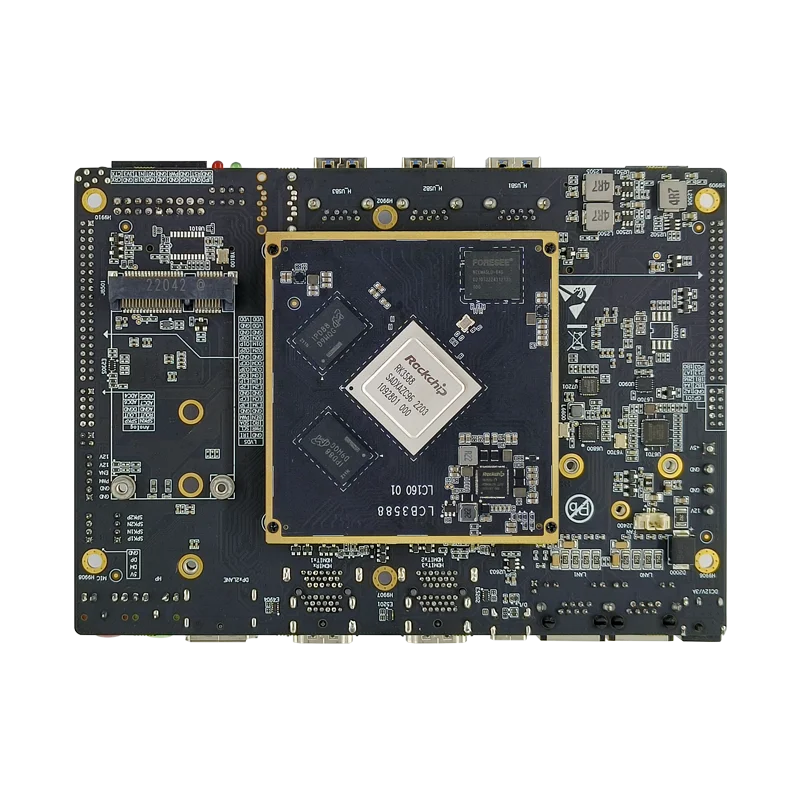
Neardi single board computer include three series, namely Rockchip Series, Nvidia Series, and NXP Series, which are developed with Rockchip, Nvidia, NXP, and other brand chips as the core CPU.
The LKD3588 is a multifunctional development evaluation board, carefully designed based on the Rockchip RK3588 chip platform. It consists of our LCB3588 core module and a baseboard. The core module and baseboard are connected by a B2B connector and fixed with 4 M2 screws, ensuring stability and reliability. The entire board features various functions, rich interfaces, and a compact, thin, and flat design, making it suitable for products with limited structural space.
The LKD3588 includes 3 Type-A USB 3.0 HOST ports, 1 Type-C USB 3.1 OTG port, and 1 USB 2.0 HOST interface with a 4-pin PH2.0 socket, allowing connection to multiple USB cameras. It has 2 mini-PCIe interfaces, which can be used to connect 4G modules and RK1808-based mini-PCIe interface NPU computing cards. The LKD3588 also supports common communication module interfaces such as dual-band Wi-Fi 6, BT 5.0, dual-channel 1000M Ethernet, UART, I2C, RS232, RS485, CANBUS, and more. It supports 3 HDMI outputs, 1 dual-channel LVDS output, 1 DP interface output, and other display interfaces, enabling multi-screen displays. Additionally, it supports multiple MIPI-CSI camera interface inputs and 1 HDMI 2.0 interface input.
The LKD3588 supports Android, Buildroot, Debian, and Ubuntu systems, offering high performance, high reliability, and high scalability. The system’s source code is open to users, allowing for secondary development and customization. Our company provides comprehensive technical support to developers and corporate users, enabling them to efficiently complete research and development work, significantly shortening the product development and mass production cycle.
The LKD3588 supports multi-channel video decoding, handling formats like H.265, H.264, and VP9 at up to 8K resolution, and allows simultaneous 4K encoding. This makes it ideal for high-performance video applications and multi-display setups.
The LKD3588 is designed with power efficiency and connectivity in mind, featuring dual Ethernet channels, Wi-Fi 6, and interfaces like RS485 and CANBUS, making it highly suited for industrial and IoT applications with reliable communication requirements.
Yes, the RK3588’s built-in NPU achieves up to 6 TOPS, supporting intensive AI tasks. The LKD3588’s additional mini-PCIe slots also allow the integration of NPU computing cards, enhancing edge processing capabilities for real-time applications.
Using active cooling, such as fans or heatsinks, especially around the core module and high-traffic areas, is recommended. Real-time thermal monitoring is essential to maintain optimal performance under sustained loads.
With USB 3.0 Type-A ports, a USB 3.1 Type-C OTG port, and a MIPI-CSI interface, the LKD3588 supports multiple camera inputs with minimal latency. Using DMA channels can further streamline data processing for applications like vision-based AI.
Efficient power management is supported through programmable low-power modes and smart shutdown configurations, enhancing reliability for continuous operation in industrial and IoT settings.
Rockchip has built a complete product matrix covering 0.5 T to 6 T computing power in the visual chip field, from entry-level smart cameras to high-end industrial vision systems, almost covering all
Understanding How the RK1820 Co-Processor Collaborates with the RK3588 Why is there increasing talk about NPUs and co-processors in edge devices? While the RK3588 is a powerful SoC with
Hi3516DV500/Hi3519DV500 Product Introduction The integration of AI into security is accelerating: AI vision has now fully permeated fields such as intelligent surveillance, edge computing, access control terminals, vehicle recognition, and
To provide the best experiences, we use technologies like cookies to store and/or access device information. Consenting to these technologies will allow us to process data such as browsing behavior or unique IDs on this site. Not consenting or withdrawing consent, may adversely affect certain features and functions.
Functional
Always active
The technical storage or access is strictly necessary for the legitimate purpose of enabling the use of a specific service explicitly requested by the subscriber or user, or for the sole purpose of carrying out the transmission of a communication over an electronic communications network.
Preferences
The technical storage or access is necessary for the legitimate purpose of storing preferences that are not requested by the subscriber or user.
Statistics
The technical storage or access that is used exclusively for statistical purposes.The technical storage or access that is used exclusively for anonymous statistical purposes. Without a subpoena, voluntary compliance on the part of your Internet Service Provider, or additional records from a third party, information stored or retrieved for this purpose alone cannot usually be used to identify you.
Marketing
The technical storage or access is required to create user profiles to send advertising, or to track the user on a website or across several websites for similar marketing purposes.